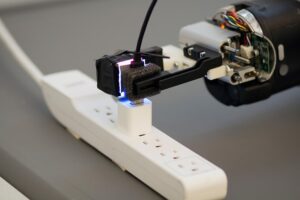
Adelson Lab invents fabulous new touch sensor!

The Adobe Flash Plugin is needed to display this content.

Congratulations Dr. Lavanya Sharan, PhD

3873663261_a6223a0b3d.jpg

ORAL DEFENSE OF DOCTORAL DISSERTATION

by Lavanya Sharan

B.Tech, Electrical Engg, IIT Delhi, 2003 S. M., Electrical Engg & Computer Science, MIT, 2005

"The Perception of Material Qualities in Real World Images"

Monday 24 August 2009 9.30 AM 32-G449 (Patil/Kiva)

Thesis Supervisor Edward H. Adelson

Abstract:

One can easily tell if a sidewalk is slippery, if food is fresh, if a spoon is made of plastic or stainless steel, or if a suspicious looking mole warrants a trip to the doctor. This ability to visually identify and discriminate materials is known as material perception and little is known about it. We have measured human material judgments on a wide range of complex, real world materials. We gathered several diverse image databases and made use of them to conduct psychophysical studies. We asked observers to classify surfaces as being made of fabric, paper, plastic or other common material categories and found that observers can make these judgments of material category reliably, quickly and in challenging conditions of rapid presentation. We found that this performance cannot be explained by simple, low-level cues like color or high spatial frequencies. In addition to categorizing materials, observers can judge many dimensions of material appearance such as matte vs. glossy, opaque vs. translucent, rigid vs. non-rigid, soft vs. rough to touch, and even `genuine' vs. `fake' for familiar objects like flowers, fruits and dessert. Observers were surprisingly accurate in their judgments, even in 40 millisecond presentations. We also compared the performance of state-of-art computer vision techniques with human performance on our images and tasks and found current techniques to be severely lacking. Taken together, our findings indicate that material perception is a distinct mechanism that can be as fast and flexible as object recognition or scene perception. When recognizing materials, low-level image information is of limited use for both humans and computer vision systems.

Thesis Committee: William T. Freeman, Polina Golland, Ruth Rosenholtz, Shin'ya Nishida

Absolutely Wascomat

The Adobe Flash Plugin is needed to display this content.

home.txt · Last modified: 2009/08/31 12:42 by elmer
-->